
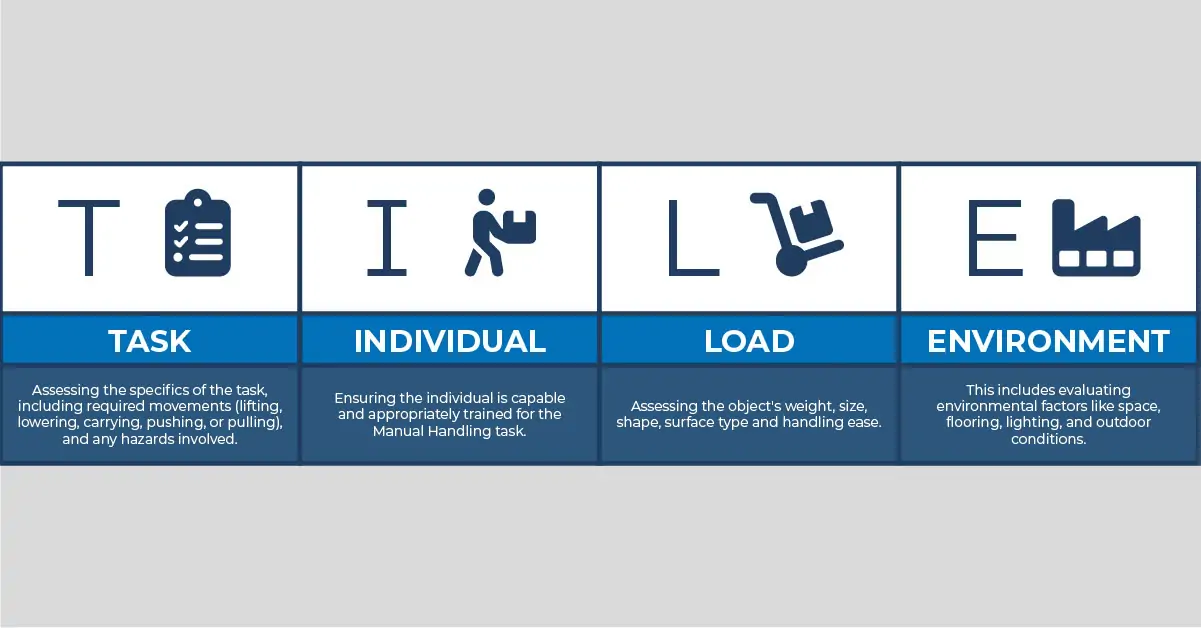
TILE stands for Task, Individual, Load and Environment. It is a memory aid for considering manual handling risks, not a legal formula or a guarantee that a lift is safe.
The TILE framework guides workers through a systematic risk assessment process. Each letter represents a key area to evaluate: the specific task being performed, the individual’s physical capabilities, the characteristics of the load being moved, and the environmental conditions surrounding the work area.
Use TILE to organise a discussion of the work, then identify practical controls. Start by considering whether hazardous handling can be avoided and use a more detailed assessment where needed.
Key takeaways
- TILE is a safety acronym representing Task, Individual, Load, and Environment for manual handling risk assessments
- Each component of TILE helps identify specific hazards and safety considerations before lifting or moving objects
- TILE supports assessment; safe work depends on effective controls, relevant training and review.
What does TILE stand for?
In manual handling, TILE means Task, Individual, Load and Environment. The factors overlap: a light load can still create risk when it is handled repeatedly or in an awkward space.
TILE in manual handling
TILE serves as a risk assessment framework for manual handling activities in workplaces. Each letter represents a critical factor workers must consider before moving objects.
- T – Task refers to the specific activity being performed. Workers examine whether the task involves repetitive movements, awkward positions, or long distances. The task assessment looks at lifting, lowering, carrying, pushing, or pulling actions.
- I – Individual focuses on the person doing the work. This considers their strength, fitness level, and physical capabilities. Workers assess whether they need assistance or have any limitations that could affect safety.
- L – Load examines the object being moved. Key factors include weight, size, shape, and stability. Workers check if the load is bulky, difficult to grasp, or has an uneven weight distribution.
- E – Environment covers the workspace conditions. This includes lighting levels, floor surfaces, space constraints, and potential hazards. Workers identify slippery floors, narrow passages, or obstacles that could cause problems.
Using the acronym in a workplace assessment
Treat TILE as a prompt for questions about the actual work. A completed four-box form is not evidence that every risk has been controlled.
The employer’s assessment should address foreseeable variations, including busy periods, unfamiliar loads and changes in staff or equipment.
Workers can use the same prompts before starting a task, to identify a change or problem and seek help when the planned method no longer fits.
Local forms may use other labels. What matters is that the assessment is suitable and sufficient and that action follows its findings.
Expansion to TILEO and variations
TILEO adds “Other factors” as a reminder to consider issues that do not fit neatly into the four headings. It does not create a separate legal standard.
Other factors might include restrictive protective clothing, time pressure or work organisation. Weather may already be covered under environment; avoid overlooking risks because categories overlap.
LITE rearranges the same prompts as Load, Individual, Task and Environment. Neither ordering is mandated by law.
Use whichever format helps the workplace examine all relevant factors clearly. The acronym alone cannot determine whether a detailed assessment is needed.
Breaking down the TILE acronym in manual handling
The TILE framework examines four essential elements that affect safety during manual handling tasks. Each component focuses on specific risk factors that workers and employers must evaluate before lifting, carrying, pushing, or pulling objects.
Task: analysing the manual handling activity
The task element examines the specific manual handling activities being performed. Workers must consider how often they repeat movements and whether the activity involves awkward positions.
Key task factors include:
- Frequency – How many times the activity occurs per hour or shift
- Duration – Length of time spent on continuous manual handling tasks
- Posture – Whether lifting requires bending, twisting, or reaching above shoulder height
- Distance – How far objects need to be moved or carried
Manual handling risk assessments should identify tasks that involve repetitive movements. These activities increase the chance of muscle strain and fatigue over time.
Strenuous movements like lifting from floor level or above head height create higher risks. Tasks requiring workers to hold loads away from their body also demand more physical effort.
Warning signs of risky tasks:
- Frequent handling with limited recovery
- Long carrying routes or a load that obstructs the view
- Working in cramped spaces
- Pushing or pulling for extended periods
Individual: assessing the person involved
The individual component focuses on the person performing manual handling activities. Physical capabilities and health conditions directly affect a worker’s ability to handle loads safely.
Age, fitness level, and previous injuries influence how much someone can safely lift. Pregnant workers, those with back problems, or recent surgery patients may need special considerations.
Individual factors to assess:
| Factor | Considerations |
|---|---|
| Physical strength | Can the person handle the required weight? |
| Health conditions | Any back problems, heart conditions, or pregnancy? |
| Experience level | Has the person received proper training? |
| Clothing | Does their uniform restrict movement? |
Training should reflect the tasks and include practical instruction where needed. It complements safer work design and equipment; it does not remove risk on its own.
If a load cannot be handled safely by one person, first consider avoiding the lift or using suitable equipment. Team handling needs its own assessment and coordination.
Load: considering the object or subject
The load refers to what is being moved during manual handling activities. Weight is important, but size, shape, and stability matter just as much for safety.
Heavy objects obviously create higher risks, but bulky items can be dangerous even when relatively light. Boxes that are difficult to grip or bags with shifting contents require extra caution.
Load characteristics to evaluate:
- Weight — what is its actual mass, and how demanding is this task?
- Size and shape – Is it bulky or awkward to hold?
- Grip points – Are there proper handles or grip areas?
- Stability — can the contents move unexpectedly?
- Temperature – Is it hot, cold, or slippery?
Manual handling risk assessments must consider how load characteristics combine with other factors. A moderately heavy box becomes much riskier when it lacks proper handles.
Sharp, hot or contaminated surfaces introduce additional hazards. Avoid exposure or select suitable equipment and protection; gloves alone may not control the risk.
Environment: evaluating surroundings and conditions
The environment encompasses all physical conditions where manual handling tasks take place. Poor lighting, uneven floors, and narrow spaces significantly increase accident risks.
Space constraints force workers into awkward positions during lifting activities. Doorways, low ceilings, and cluttered areas make safe manual handling much more difficult.
Environmental hazards include:
- Floor surfaces – Wet, uneven, or slippery conditions
- Lighting levels – Insufficient illumination for safe movement
- Temperature – Extreme heat or cold affecting worker performance
- Space limitations – Narrow corridors or low overhead clearance
- Obstacles – Steps, cables, or equipment blocking pathways
Weather conditions affect outdoor manual handling activities. Rain, ice, and strong winds create additional safety challenges that require proper planning.
Consider heat, cold and ventilation alongside the physical work. Adjust the task if conditions make the handling difficult or uncomfortable.
Essential environmental checks:
- Clear, well-lit pathways
- Non-slip flooring surfaces
- Adequate space for safe movement
- Proper temperature control
- Removal of trip hazards
Importance of TILE in manual handling safety
TILE helps organise the questions used in an assessment. Risk reduction depends on acting on the findings and checking the chosen controls in practice.
Risk reduction and injury prevention
The TILE framework helps employers identify potential dangers before workers get injured. By checking each element systematically, companies can spot problems early and fix them.
Task assessment reveals if workers need to lift too much or move things too often. These actions can cause back injuries and muscle strain. When employers find these risks, they can change how work gets done.
Individual factors can identify where an adjustment, different aid or additional instruction is needed. Do not assume capability from age, sex or appearance alone.
Load analysis shows if objects are too heavy or awkward to move safely. Workers often get hurt when they cannot grip items properly or when loads shift unexpectedly.
Environmental checks can identify wet floors, poor lighting and restricted space. Improve these conditions before asking workers to compensate through technique.
A useful assessment identifies what must change, who will act and how effectiveness will be checked. There is no fixed reduction in injuries from using the acronym itself.
The role of TILE in manual handling training
Manual handling training programmes use TILE to teach workers how to stay safe. The framework gives trainers a clear structure to follow when teaching lifting techniques.
Workers learn to check each TILE element before they start any manual handling task. This creates a habit of thinking about safety first.
Training courses show real examples of how to use TILE. Workers practice identifying risks in different situations. They learn when to ask for help or use lifting equipment.
Key training benefits include:
- Better understanding of lifting risks
- Improved decision-making about manual handling
- Increased use of proper lifting techniques
- More requests for help when needed
Employers must provide appropriate information, instruction and training. The law does not require a course named TILE or a particular certificate.
Impact on musculoskeletal health
MSDs can affect muscles, joints and tendons and may have several contributing factors. Handling, repetition and awkward posture are among the risks to assess.
Common manual handling injuries include:
- Lower back pain and disc problems
- Shoulder and neck strain
- Wrist and hand injuries
- Knee and ankle problems
An assessment helps identify preventable demands, but it cannot guarantee that an injury will not occur. Act on the findings and review symptoms or difficulties.
Workers should understand when to stop and seek assistance. The employer must provide a workable method rather than expecting personal judgement to compensate for an unsafe task.
Monitor practical outcomes such as reduced effort, improved access and worker feedback. No universal percentage reduction in MSDs can be promised from a risk assessment.
Encourage early reporting of discomfort and review the work. Persistent symptoms may also need clinical or occupational health advice.
Practical application of TILE in the workplace
Using TILE properly requires following specific steps to assess risks and create safer work environments. This framework helps employers reduce injuries and meet safety requirements through systematic evaluation.
Conducting a manual handling risk assessment
A proper manual handling risk assessment starts with examining each part of TILE systematically. Workers should first identify all manual handling tasks in their workplace, from lifting boxes to moving equipment.
Task assessment involves looking at the specific movements required. Does the job need twisting, bending, or reaching above shoulder height? How often must workers repeat these actions? Long distances and awkward positions increase risk levels.
Individual assessment checks if workers can safely complete the task. Consider their fitness levels, training, and any health conditions. Some people may need help or different equipment to work safely.
Load assessment covers mass, shape, grip, stability and surface hazards. There is no universal 23kg threshold that separates safe and unsafe handling.
Environment assessment reviews the work area conditions. Poor lighting, wet floors, narrow spaces, and obstacles all make manual handling more dangerous. Temperature extremes can also affect worker performance and safety.
Implementing safe manual handling practices
First consider whether hazardous handling can be avoided. Mechanical aids may reduce manual effort, but assess their own risks and any loading or unloading tasks that remain.
If hazardous handling remains, improve the load, method and environment and provide suitable aids. Use instruction, practical training and supervision to support those controls.
Choose aids suited to the task, such as a trolley or lifting table, and assess the risks of using them. Do not rely on a back-support belt to make a hazardous lift safe.
Create clear procedures for each manual handling task. Written instructions help workers remember the safest methods. Regular reviews keep these procedures up to date with workplace changes.
Keep floors and routes maintained, lighting adequate and access clear. Check that these conditions remain suitable throughout the task.
Applying TILE to different tasks
The same prompts can be applied to different work, but the answer must reflect the actual operation. These examples illustrate questions to ask rather than approved transfer or lifting instructions.
Boxes and deliveries
Task — consider unloading height, carrying distance and how often deliveries arrive. Avoid unnecessary lifting or move the delivery point where practicable.
Individual — check who will receive the delivery and what equipment and instruction they need. Do not leave an unfamiliar heavy load for an unprepared worker.
Load — obtain weight information and check packaging, grip and stability before handling. A damaged box may require a different method.
Environment checks might include:
- A clear delivery route
- Suitable floor condition and gradients
- Space for handling equipment
- A suitable place to put the load
Agree the receiving method before the delivery arrives. If conditions differ from the plan, stop and seek a revised method.
Tools and construction materials
Task — identify repeated movements and the need to lift materials into position. Consider prefabrication, smaller packs or mechanical assistance.
Individual — ensure workers understand the planned method and the equipment. Consider relevant restrictions and avoid relying on assumed strength.
Load — assess sharp edges, awkward shapes and unstable bundles as well as mass. Secure or repackage items where necessary.
Environment — check access, ground condition, changes in level and weather. A route that was suitable earlier may become obstructed or slippery.
Review the handling method as the work progresses. Reassess where the location, material or equipment changes.
Pushing and pulling equipment
Task — consider the effort needed to start, steer and stop the load. A wheeled aid reduces carrying but may introduce pushing and pulling risks.
Individual — check whether the worker can see the route and control the equipment without excessive leaning or twisting.
Load — assess the equipment’s rated load, stability, handles, castors and brakes. Damaged wheels can increase effort.
Environment — examine gradients, thresholds, floor damage and available turning space. Avoid trapping feet or hands against obstacles.
Use an appropriate assessment method, such as HSE’s RAPP tool, if screening does not establish low risk. The mass alone cannot establish the force needed.
Assisting people to move
Task — identify the specific movement, such as standing, repositioning or transfer to a chair. Assistance should reflect the person’s wishes and assessed needs.
Individual — consider the person being assisted and the staff carrying out the transfer. Relevant ability, communication and health needs may change.
Load — a person is not a passive object. Movement, pain or loss of balance can change the demands during a transfer.
Environment — check room layout and compatibility of the bed, chair, hoist or other aid. Allow enough space for the assessed method.
Follow the individual care plan and equipment instructions. TILE does not replace specialist people-handling assessment or practical training.
Summary and key takeaways
TILE is a memory aid used when assessing manual handling. It helps organise questions before deciding how to avoid or control hazardous work.
The acronym stands for four key areas:
- T – Task (the activity being performed)
- I – Individual (the person doing the work)
- L – Load (the object being moved)
- E – Environment (the surrounding area)
The headings prompt consideration of interacting factors. Their value comes from the assessment and action they support.
TILEO adds a fifth element – Other factors. This includes personal protective equipment and additional considerations.
LITE uses the same four elements as TILE. The letters appear in different order but mean the same thing.
| Acronym | Elements |
|---|---|
| TILE | Task, Individual, Load, Environment |
| TILEO | Task, Individual, Load, Environment, Other |
| LITE | Load, Individual, Task, Environment |
Use the framework alongside suitable assessment tools and professional advice where needed. It does not give a safe weight or an injury-prevention guarantee.
Check whether the planned method fits current conditions before starting. Stop and seek help if equipment, access or the load has changed.
Different tasks need different levels of assessment. Handling people, team lifts and complex operations require attention beyond a simple checklist.
Review the assessment when it may no longer be valid or work changes significantly. Involve the workers who carry out the task.
Related guides
- Manual Handling Risk Assessment Guide for Workplaces
- Manual Handling Weight Limits: UK Safe Lifting Guide
- Manual Handling Injuries: Key Risks & Prevention
- Hoists in Care Homes: Safe Moving & Handling Guide
- Construction Workplace Injury Statistics UK: 2026 Facts, Data & Key Insights
- Forklift Accident Statistics UK: 2026 Facts, Data & Key Insights
- RIDDOR Statistics UK: 2026 Facts, Data & Key Insights
Sources & references
- HSE — Manual handling at work
- HSE — Simple manual handling risk filters
- HSE — Manual handling training
- HSE — Assess manual handling you cannot avoid
- HSE — Managing risks and recording findings
- Manual Handling Operations Regulations 1992, as amended
- HSE — L23 guidance on the Manual Handling Operations Regulations
- HSE — Risk Assessment of Pushing and Pulling (RAPP)
- HSE — Moving and handling: managing the risk
- HSENI — Manual handling and Northern Ireland duties
Make sure your team is trained in safe manual handling.
Explore the Manual Handling Training Course →
Mark writes about workplace health & safety, manual handling and accredited online training for Manual Handling Training, part of Online CPD Academy.