
There is no universal legal maximum weight for lifting at work. In Great Britain, the Manual Handling Operations Regulations 1992 require employers to avoid hazardous handling where reasonably practicable, assess unavoidable risks and reduce them. Northern Ireland has separate equivalent regulations.
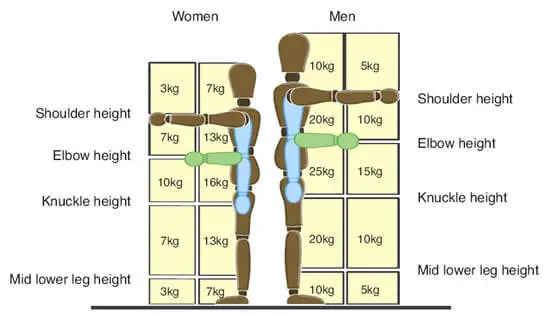
HSE’s lifting diagram, shown above, is a screening filter for identifying some low-risk tasks. Its figures are not safe limits, personal lifting targets or permission to lift a particular weight.
Use the figures to decide whether detailed assessment is needed, then act on the risks identified. Safer work design, suitable aids and relevant training matter more than a single number.
- 25kg HSE filter value for men when hands stay close to the body between knuckle and elbow height; not a safe maximum.
- 16kg corresponding HSE filter value for women in that same zone; individual capability still matters.
- 2 minutes lifting more often than once in this period requires a more detailed assessment under HSE’s simple filter.
- 1992 the year the Great Britain regulations were made; they came into force on 1 January 1993.
Key takeaways
- UK law requires risk-based assessments rather than enforcing specific weight limits for manual handling.
- Employers must avoid hazardous handling where reasonably practicable and reduce remaining injury risks as low as reasonably practicable.
- Relevant training supports suitable equipment, effective controls and timely review.
Understanding manual handling weight limits
HSE’s diagram uses population-level lifting-capacity data for men and women. It does not prescribe what an individual can safely lift. The task and the person still need consideration.
Understanding HSE’s screening values
The filter helps decide whether a more detailed assessment is needed. It assumes a load that is easy to grasp with both hands, reasonable conditions and a stable stance; it does not cover every handling situation.
The law does not set specific weight limits for manual handling. Instead, employers must assess each situation based on the task, the load, and the working environment.
Manual handling includes supporting or moving a load by hand or bodily force. Risk depends on several factors:
- How close the load is held to the body
- The height at which lifting occurs
- The worker’s individual capability
- The working environment conditions
Provide general information about load weight and imbalance. Where reasonably practicable, give precise weight information and identify the heaviest side if the centre of gravity is not central.
The guidelines aim to reduce injury risk rather than set absolute limits. Each workplace situation requires individual evaluation to determine safe lifting practices.
HSE lifting filter figures for men
The highest figure in HSE’s diagram is 25kg for men, with the hands close to the body between knuckle and elbow height. A task within this value is not automatically safe.
Examples from other zones in the diagram are:
- Above shoulder height, close to the body: 10kg filter value
- Below mid-lower-leg height, close to the body: 10kg filter value
- Hands further from the body, between knuckle and elbow height: 15kg filter value
Use the lowest value for every zone the hands pass through. The 25kg figure does not apply throughout the area between knuckle and shoulder height.
If lifting occurs more often than once every two minutes, involves twisting or team handling, or falls outside other filter conditions, carry out a more detailed assessment.
HSE lifting filter figures for women
The corresponding highest filter figure for women is 16kg, close to the body between knuckle and elbow height. It is a screening value, not a personal safe maximum.
Examples from other zones in the diagram are:
- Above shoulder height, close to the body: 7kg filter value
- Below mid-lower-leg height, close to the body: 7kg filter value
- Hands further from the body, between knuckle and elbow height: 10kg filter value
The diagram is based on population differences, not a test of an individual’s strength. Consider health, experience, pregnancy, disability and other relevant circumstances.
The table summarises selected filter zones only. Follow the full HSE filter and use a detailed assessment whenever its conditions are not met or there is doubt about the risk.
| Selected HSE filter condition | Men: filter value | Women: filter value |
|---|---|---|
| Hands close, between knuckle and elbow height | 25kg | 16kg |
| Above shoulder height, close to body | 10kg | 7kg |
| Below mid-lower-leg height, close to body | 10kg | 7kg |
| Hands further away, knuckle–elbow height | 15kg | 10kg |
| More than one lift every two minutes | Detailed assessment | Detailed assessment |
Legal framework and guidance
The Manual Handling Operations Regulations 1992 set duties in Great Britain. HSE guidance supports assessment; a number in a diagram does not replace the employer’s duty to control risk.
Manual Handling Operations Regulations 1992
The 1992 Regulations, as amended, establish a three-step approach to managing hazardous manual handling in Great Britain.
First avoid hazardous manual handling wherever reasonably practicable. Assess remaining hazardous operations in enough detail to identify the controls needed.
Key requirements:
- Avoid hazardous manual handling where reasonably practicable
- Assess unavoidable hazardous manual handling operations
- Reduce risks to the lowest level reasonably practicable
The regulations do not set specific weight limits for lifting operations. Instead, they require case-by-case assessment considering multiple factors including the task, load characteristics, working environment, and individual capabilities.
Role of the Health and Safety Executive (HSE)
The HSE provides guidance to help employers comply with manual handling regulations. They publish detailed guidance documents explaining how to interpret and implement the legal requirements effectively.
HSE guidance emphasises that no universal weight limits exist under the regulations. Instead, they provide guideline figures that indicate when more detailed risk assessments should be carried out for specific operations.
The HSE recommends employers consider:
- Task factors: frequency, duration, posture requirements
- Load characteristics: weight, size, shape, stability
- Working environment: space constraints, floor conditions, lighting
- Individual capability: physical fitness, training, experience
HSE guidance documents include practical tools and checklists to support employers in conducting proper risk assessments and implementing appropriate control measures.
Employer responsibilities
Employers hold primary responsibility for protecting workers from manual handling injuries under the regulations. They must establish systematic approaches to identify, assess, and control manual handling risks across their operations.
Core duties include:
- Conducting suitable and sufficient risk assessments
- Providing appropriate training and information to workers
- Implementing control measures to reduce risks
- Monitoring and reviewing manual handling procedures regularly
Provide general indications of load weight and imbalance, with precise weight and the heaviest side where reasonably practicable. Include this information in the handling plan.
Training programmes should cover safe lifting techniques, risk recognition, and proper use of mechanical aids. Employers must also consider individual worker capabilities when assigning manual handling tasks and making reasonable adjustments where necessary.
Key factors influencing lifting risk
Several critical factors determine whether a lifting task poses a risk of injury. These include the nature of the task itself, the person’s physical capabilities, the characteristics of the load, and the working environment.
TILE principle: Task, Individual, Load, Environment
TILE — Task, Individual, Load and Environment — is a useful reminder of assessment factors. It does not calculate a universal safe weight.
Consider the frequency and duration of handling, recovery time and carrying distance. Repeated handling can require controls even when each load is light.
Individual factors vary significantly between workers. Age, fitness level, and existing health conditions influence lifting capacity. Previous injuries can reduce a person’s ability to handle certain weights safely.
Load characteristics extend beyond weight alone. The size and shape of objects affect grip quality. Items with handles or good grip points allow for safer lifting than awkward or smooth objects.
Environment conditions play a crucial role in safety. Poor lighting, uneven surfaces, and temperature extremes increase injury risk. Cramped spaces force workers into awkward positions during lifting and carrying tasks.
Body position and grip
Posture affects the physical demands of handling. Design the work to avoid awkward reaching and prolonged bending.
Keeping a load close reduces the reach involved. It does not make an otherwise hazardous task acceptable.
Grip quality determines control over the load. Poor grip increases the risk of dropping objects and forces workers to use excessive muscle tension. Wet or slippery surfaces on objects reduce grip effectiveness.
Avoid twisting with a load; change direction by moving the feet. Twisting also takes a lift outside the simple screening filter.
Height and proximity of the lift
Assess both the start and finish heights and every zone crossed. Floor-level or overhead work can require changes to storage or handling equipment.
Keep frequently handled loads at a convenient height where practicable. In HSE’s filter the highest values apply between knuckle and elbow height, close to the body.
Plan overhead handling separately; consider lowering storage or using suitable equipment to reduce reaching.
Reach distance affects the demand on the body. Arrange access so workers can get close to the load without overreaching.
Risks associated with manual handling
Manual handling can cause sudden injury or contribute to symptoms that develop over time. Load, repetition, posture, working conditions and individual factors can act together.
Common manual handling injuries
Handling can affect the back, upper limbs and other body parts. Dropped loads can also cause cuts, bruises or crushing injuries.
Acute injuries happen suddenly during lifting or moving tasks. These include:
- Lower back strains and sprains
- Muscle tears in shoulders and arms
- Herniated or slipped discs
- Cuts and bruises from dropped objects
- Crushing injuries to hands and feet
Upper limb injuries frequently occur when workers reach awkwardly or lift above shoulder height. The shoulders, wrists and elbows are particularly vulnerable.
Foot and hand injuries happen when loads slip or fall. Heavy objects can cause fractures or severe bruising. Sharp edges on loads create cuts that may require medical treatment.
Many injuries occur because workers underestimate the weight of objects or attempt to lift beyond their physical capabilities.
Development of musculoskeletal disorders (MSDs)
Musculoskeletal disorders affect muscles, joints and tendons. They can develop gradually or follow an injury, and may have several contributing factors.
Common MSDs from manual handling include:
- Chronic lower back pain
- Neck and shoulder pain
- Tendonitis in shoulders and wrists
- Muscle weakness and stiffness
- Joint inflammation
Report persistent or recurring symptoms and review the work. Symptoms do not always mean progressive structural damage, and appropriate healthcare advice may help.
Back pain has several possible causes. An assessment should focus on reducing harmful demands rather than assuming every ache is spinal damage.
Repeated overhead work can contribute to shoulder problems. Reduce exposure and seek clinical advice for symptoms that persist or limit activities.
Impact of repeated or poor lifting
Awkward or repetitive handling can increase risk. Good technique helps but cannot compensate for unsuitable loads, poor work design or inadequate recovery.
High-risk lifting behaviours include:
- Sustained stooping or awkward reaching
- Twisting whilst carrying loads
- Lifting too quickly or jerky movements
- Carrying objects far from the body
- Lifting beyond individual capability
Vary tasks and provide suitable recovery opportunities. Check whether the overall workload is manageable rather than relying on strength alone.
Workers who lift frequently without adequate rest periods face higher MSD risks. The body needs recovery time between demanding manual handling tasks.
Review the work if workers report pain or difficulty. Persistent back pain merits healthcare advice; its cause cannot be diagnosed from lifting posture alone.
Best practices for safe manual handling
Start with avoiding hazardous handling and improving the task, load and workplace. Appropriate technique and training support these measures.
Safe lifting techniques
Correct body positioning forms the foundation of safe manual handling. Workers should position themselves close to the load with feet hip-width apart and one foot slightly forward for balance.
For a basic two-handed lift, start with a slight bend at the back, hips and knees. Avoid a deep squat or fully stooped posture, and do not bend the back further as the load rises.
Grip and posture are equally important. Maintain a firm hold on the load using both hands whenever possible. Keep the heaviest side of the object against the body to reduce strain on the spine.
Workers must avoid twisting motions during lifting and carrying. Instead, move the feet to change direction. Keep shoulders level and facing the same direction as the hips throughout the task.
Once the load is securely held, keep the head up and look ahead. Ensure the load does not obstruct the route.
Preparing for manual handling
Risk assessment should occur before any manual handling task begins. Workers must evaluate the load weight, size, and shape to determine if assistance or equipment is needed.
Clear the intended path of obstacles, debris, or hazards. Check that floors are dry and level to prevent slips or trips during transport.
Load inspection reveals potential dangers. Look for sharp edges, unstable contents, or damaged packaging that could affect grip or cause injury during handling.
Plan the destination before lifting. Ensure adequate space exists at the drop-off point and that the surface can support the load safely.
Take account of fatigue, symptoms and any agreed restrictions. Stretching or warming up does not make a hazardous task safe.
Obtain weight information and plan before lifting. Do not attempt a trial lift to discover whether an unknown load is safe; seek help if unsure.
Appropriate use of lifting aids
Mechanical aids should be the first choice for heavy or awkward loads. Trolleys, hoists, and conveyor systems eliminate much of the physical strain associated with manual handling.
Select equipment appropriate for the specific task. Wheeled devices work well for moving loads horizontally, whilst hoists and lifts handle vertical movement more safely.
Check and maintain aids in accordance with their instructions. Remove unsafe equipment from use and follow the relevant inspection and examination requirements.
Assess team lifts separately. Consider differences in height, strength and reach, agree who will coordinate, and use clear signals.
Do not assume two people can safely lift twice one person’s load. Plan how weight will be shared and whether suitable equipment can avoid the team lift.
Train staff in the equipment they use, including its rated load, attachments and safety features. Check competence before independent use.
Wearing suitable footwear and equipment
Choose footwear with grip suitable for the floor and task. Check condition and fit; footwear does not replace a clear, maintained route.
Avoid high heels, loose-fitting shoes, or footwear with worn soles. Steel-toed boots offer additional protection when handling heavy or sharp objects.
Select gloves for the hazards and grip required. Gloves that are bulky, slippery or poorly fitted can make handling harder.
Remove jewellery that could catch on objects or interfere with grip. Loose clothing can also pose hazards by snagging on loads or equipment.
Do not rely on back-support belts as a substitute for reducing manual handling risks. They do not make an excessive load or awkward task safe.
Ensure clothing allows full range of motion. Tight or restrictive garments can limit movement and increase injury risk during manual handling activities.
Training, assessment, and continuous improvement
Relevant training supports practical controls. Assessment and monitoring should check that the work can be performed safely under the actual conditions.
Importance of manual handling training
Manual handling training provides workers with the knowledge and techniques needed to lift, carry, push, and pull loads safely. Without proper training, employees may use poor lifting techniques that increase their risk of back injuries and musculoskeletal disorders.
Training programmes teach workers how to assess loads before lifting them. They learn to consider factors such as weight, size, shape, and grip points. Workers also discover when to seek help or use mechanical aids instead of lifting manually.
Key training topics include:
- Correct lifting posture and technique
- How to plan lifting tasks
- Recognising hazardous situations
- Using lifting equipment properly
- Understanding individual limitations
Provide instruction before unfamiliar work and refresh it when risks, equipment or competence needs change. Check that workers understand the planned method.
Undertaking a manual handling course
Training length depends on the work and learner’s needs. General online awareness should be supplemented with task-specific instruction, practical training and supervision where needed.
Professional training providers offer courses designed for different industries and risk levels. Some courses focus on general manual handling principles. Others target specific sectors like healthcare, construction, or warehousing.
Course content usually includes:
- Legal responsibilities under health and safety regulations
- Anatomy and injury prevention
- Risk assessment techniques
- Practical lifting exercises
- Equipment selection and use
Managers and supervisors benefit from additional training on conducting risk assessments and implementing control measures. This training helps them identify problems and coach workers on safe techniques.
A course certificate records learning completed. It does not by itself prove practical competence or compliance with all training duties.
Conducting and reviewing risk assessments
Risk assessments form the foundation of effective manual handling safety programmes. Employers must assess all manual handling tasks that could cause injury to workers.
The assessment process examines four key factors: the task, the load, the working environment, and individual capability. Assessors look at how these factors interact to create risks.
Assessment steps include:
- Identifying manual handling tasks
- Evaluating risk factors
- Determining likelihood and severity of injury
- Implementing control measures
- Recording findings and actions
Review an assessment if it may no longer be valid or the work changes significantly. Incidents, symptoms and worker concerns may trigger a review; there is no universal monthly or quarterly interval.
Workers should participate in risk assessments by sharing their experiences and concerns. Their input helps identify practical solutions and increases buy-in for safety measures.
Sources & references
- HSE — Manual handling at work
- HSE — Simple manual handling risk filters
- HSE — Good handling technique
- HSE — Manual handling training
- HSE — Managing risks and recording findings
- Manual Handling Operations Regulations 1992, as amended
- NHS — Back pain
- HSENI — Manual handling and Northern Ireland duties
Make sure your team is trained in safe manual handling.
Explore the Manual Handling Training Course →
Mark writes about workplace health & safety, manual handling and accredited online training for Manual Handling Training, part of Online CPD Academy.